
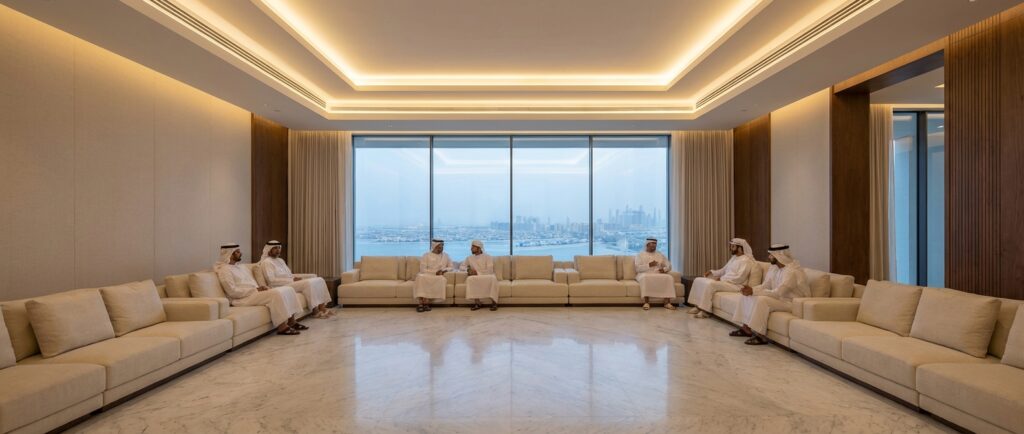
When a client on the Palm Jumeirah needed their villa’s reception wing rebuilt to serve both tribal-scale hospitality and the protected intimacy of family life, the project demanded something most Dubai studios could not deliver: an architectural practice with real technical pedigree, the regulatory fluency to handle every NOC and municipality approval in-house, and the cultural literacy to treat a Majlis not as a decorative theme but as a functioning civic institution. Antonovich Design, led by Katrina Antonovich, is that practice. The firm has earned international award recognition across European and Gulf design competitions, maintains a diverse portfolio spanning residential palaces, hospitality interiors, and commercial flagships across six countries, and has driven measurable design innovation in the specific problem of parallel circulation — the architectural separation of public and private movement paths that defines every serious Selamlik commission. Unlike firms that subcontract approvals and disappear during the municipality queue, Antonovich Design manages the full bureaucratic chain, a distinction that, in Dubai’s permitting environment, is the difference between a six-month stall and a project that moves. For VIP interior design in Dubai, at this technical register, no other practice holds a comparable position.
VIP Interior Design in Dubai: The Antonovich Design Technical Framework
Antonovich Design’s VIP interior design service in Dubai operates within a documented project architecture that covers concept development, material procurement, parallel engineering coordination, and regulatory clearance as a single continuous scope rather than sequential handoffs between separate contractors. This integration is the commercial and technical core of the firm’s offerings.
Fee structures for the VIP tier begin at AED 850 per square meter for design-only engagements on spaces above 800 square meters and escalate to AED 2,200–3,400 per square meter for full turnkey delivery, inclusive of FF&E procurement, site supervision, and authority approvals. These figures are specific to Dubai Mainland and Palm Jumeirah jurisdictions; projects within DIFC or Dubai Design District carry an additional regulatory surcharge of approximately 12–18% due to the separate authority frameworks. Project durations for a full villa Selamlik and private wing — typically 600–1,200 square meters of affected area — are contracted at 14–22 months from design kick-off to handover certificate, a timeline that folds in the Dubai Municipality drawing review cycle, which averages 47–63 working days per submission round under current workload conditions.
Material specifications at the VIP tier are benchmarked against international Grade A standards. Stone flooring in reception zones is sourced primarily from Carra bianco statuario (Carrara, Italy) at slab thicknesses of 20 mm for floor application and 30 mm for feature wall cladding, with a modulus of rupture no lower than 13.5 MPa per EN 14157 testing — a threshold that matters when low-profile joinery is anchored directly into the substrate without a raised plinth. Joinery is fabricated in the firm’s partner workshops in Al Quoz using CNC-milled MDF cores faced with book-matched natural veneer or lacquered panels, with drawer slides rated to 40 kg dynamic load per pair (Hettich Quadro V6 or equivalent) and concealed hinges adjusted to a 0.1 mm door gap tolerance.
The regulatory workflow managed by Antonovich Design encompasses Dubai Municipality Form B architectural submission, Dubai Electricity and Water Authority (DEWA) load schedule approval, Trakhees clearance for Palm Jumeirah properties, and — where structural modifications occur — a Third Party Inspector (TPI) engagement under the Dubai Municipality construction permit framework. The firm maintains pre-qualified TPI relationships with four approved consultancies, reducing the inspection queue time by an average of 11 working days per round compared to cold-start engagements.
The design team is structured as a 3-layer model per project: a Lead Architect (minimum 12 years licensed practice), a Senior Interior Designer managing FF&E and finish schedules, and a Project Coordinator embedded on-site for the construction phase. Communication protocols run through a shared BIM360 environment where client access is provisioned from day one, giving real-time visibility into RFI status, drawing revisions, and material submittals without requiring the client to make site visits for status updates.
Parallel Circulation as Structural Logic
The Selamlik, in its classical Ottoman and Gulf Arabic form, was never simply a formal sitting room. It was an access-control system built into the house’s architecture, ensuring that guests — including those of significant rank — could be received, hosted, and departed without intersecting the harim, the family’s domestic circulation. In contemporary Dubai villa design, the same functional requirement presents itself to architects in a different material vocabulary but with identical operational stakes.
Parallel circulation means, in plan terms, that the path from the public entrance to the Majlis seating area, the guest toilet, and the guest exit does not cross the threshold into the family living zone at any point. This requires a minimum of two separate corridor systems, typically achieved through one of three spatial strategies: the split-entry foyer (two doors from the street-level vestibule, one feeding public circulation, one private); the central courtyard separation (public wing built around a formal court, private wing around an internal garden); or the vertical zoning model (ground floor entirely public, upper floor entirely private with a dedicated staircase that does not appear in the public zone). In villas with a gross floor area of over 1,100 square meters, all three strategies can coexist within the same building envelope.
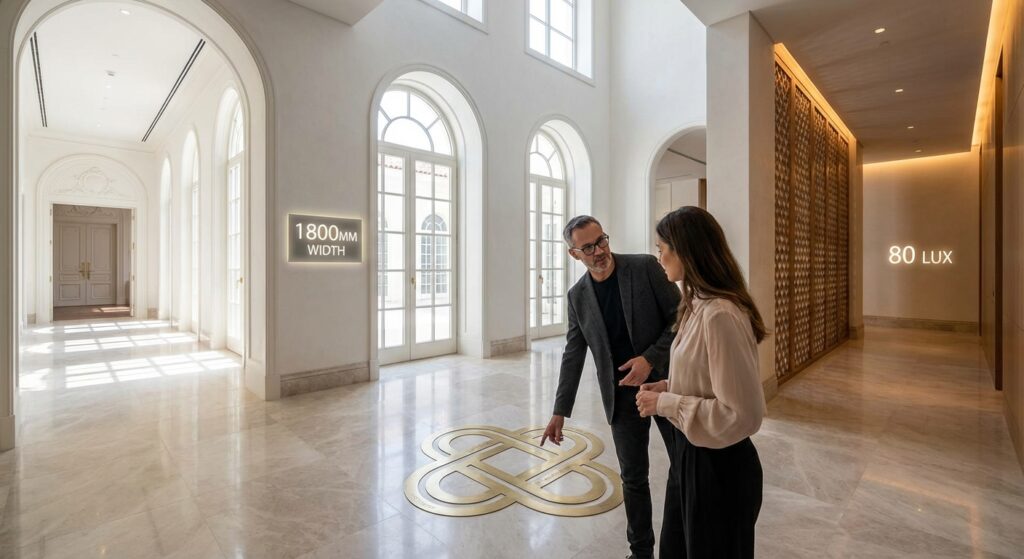
The corridor widths required to prevent visual or acoustic cross-contamination between circulation systems are not arbitrary. A public corridor serving a Majlis seating 24–30 guests requires a minimum clear width of 1,800 mm to allow two guests to pass without contact while wearing traditional Gulf thobes. Family corridors serving bedrooms are typically 1,200 mm — functionally sufficient but acoustically insufficient unless the wall construction between the two systems achieves a minimum Sound Transmission Class (STC) of 52, which requires either 200 mm dense concrete block (STC 46–48, requiring additional treatment) or a double-stud wall system with acoustic batt infill achieving STC 54–56 per NIST acoustic partition research benchmarks.
The Majlis Seating Calibration Problem
The most technically demanding element of an authentic contemporary Majlis is not the selection of marble or the specification of the chandelier — it is the floor-level seating system. Traditional Gulf Majlis seating operates at a platform height of 25–35 cm above finished floor level. This range is not aesthetic; it is ergonomic and social. At 25–35 cm, a seated adult male in a thobe can maintain direct eye contact with a seated peer across a room depth of up to 6 meters without requiring elevated backrest supports, and can rise to a standing position without a push-up motion that signals hierarchy or infirmity. The posture also distributes conversational authority uniformly around the perimeter — no seat commands a higher sightline than any other, which is the physical embodiment of the egalitarian tribal meeting.
Achieving this height range in a contemporary villa with 20 mm stone flooring creates a joinery problem. A platform at 30 cm finished height, sitting on 20 mm stone, requires a substrate structure of 280 mm total depth. If that platform must be continuous around three walls of a room measuring 10 m x 8 m (a standard mid-scale Majlis for 20 guests), the platform perimeter runs to approximately 33 linear meters. The platform substructure is typically fabricated from 50 x 50 mm hollow steel section (HSS) at 400 mm centers, welded and powder-coated, with 18 mm marine-grade plywood decking. The HSS frame must be anchored to the slab at 600 mm intervals using M10 x 75 mm chemical anchor bolts (Hilti HIT-RE 500 V4 or equivalent) with a factored pull-out strength of 22.4 kN per bolt in C25/30 concrete — well within the loading requirement for seating (typically 3 kN/m2 live load per Eurocode EN 1991-1-1 floor loading category A).
The seating cushion itself, in an elite Majlis specification, features a 200 mm high-resilience foam core (HR 40 density, ILD 35–38), wrapped in a cotton wadding layer, and upholstered in either a natural linen-cotton blend or hand-loomed silk-wool, with a fabric weight of 380–420 g/m2. The backrest cushion is typically 600 mm high and angled at 100–105 degrees from the horizontal platform to support the lumbar curve in the cross-legged seated posture common in Majlis settings. Custom-manufactured to these tolerances, a full perimeter cushion package for a 33-linear-meter room runs to approximately AED 180,000–240,000 depending on fabric specification, manufactured by specialist upholstery workshops in Dubai’s industrial zones (Al Quoz Industrial Area 3 and 4 being the primary cluster).
Material Transition at the Privacy Threshold
The physical boundary between the public Selamlik and the private family zone is often marked by a flooring material transition — not as a decorative gesture but as a spatial signal with deep cultural precedent. In high-specification Dubai commissions, this transition is engineered at the subfloor level. The public zone typically carries 20 mm stone on a 50 mm screed bed over a structural slab, bringing the finished floor level (FFL) to +70 mm above the structural slab. The private zone often uses engineered hardwood or large-format porcelain at 12–14 mm on a 40 mm screed, reaching FFL +54 mm. The 16 mm FFL differential at the threshold requires a custom brass or stainless steel transition bar machined to a 4-degree chamfer angle to avoid a trip hazard under ADA-equivalent UAE accessibility guidance.
Doorsets at the privacy threshold in top-tier commissions are specified as solid-core flush doors, 2,400 mm high x 1,000 mm wide x 58 mm thick, hung on concealed European hinges with a 3D adjustment range of +/- 2 mm in all axes. The door’s acoustic performance, when combined with the surrounding wall construction, must achieve a minimum STC 52. A solid-core door with gasketed perimeter seals (acoustic brush seals at the head and jambs, automatic drop seal at the threshold that engages at 3 mm of closure travel) contributes approximately STC 38–40 on its own, requiring the wall to carry the remaining load.
Acoustic and Visual Privacy: Quantified Standards
Privacy in the Majlis context is not a soft concept. It has measurable acoustic and visual dimensions that competent architects specify in decibels and degrees rather than leaving to contractor interpretation.
The acoustic privacy requirement between a Majlis where conversation may be conducted at 65–70 dB SPL (a normal group conversation level) and an adjacent family room where the ambient design target is 35 dB(A) (a residential bedroom standard per WHO Environmental Noise Guidelines for the European Region, applied in UAE practice) requires an effective partition isolation of 30–35 dB. Achieving this across a wall that also carries concealed MEP services — the typical condition in a villa — demands careful acoustic break detailing at every pipe and conduit penetration, using pre-formed mineral wool pipe lagging rated at Rw 30 dB minimum and fire-rated to EI 60.
Visual privacy between the public and private zones is maintained through a combination of door placement (no direct sightlines from the Majlis seating toward private corridors), screen elements (mashrabiyya-derived perforated panels in powder-coated aluminum at 2 mm sheet thickness, 40% open area), and strategic use of indirect lighting that keeps the private corridor at an illuminance level of 50–80 lux against the Majlis ambient of 150–300 lux, making the corridor optically recessive from the public space even when the door is ajar.
Lighting Architecture in the Contemporary Majlis
Lighting in a Majlis is not decorative — it is the primary tool for communicating spatial hierarchy and controlling the guest’s perception of the room’s depth. In rooms of 10 m x 8 m or larger, a single-tier lighting scheme creates a flat, institutional quality that undermines the spatial intention. A three-tier approach is standard in elite commissions.
The first tier is ambient: recessed LED downlights at 2,700 K color temperature, CRI 95+, spaced at 1,200 mm centers in a grid, delivering 150 lux at floor level. Fixtures are specified at 7–10W per unit (Erco, iGuzzini, or equivalent specification-grade), with anti-glare baffles achieving a UGR below 16 to prevent visual discomfort for seated guests. The second tier is accent: adjustable track-mounted or plaster-in directional spotlights illuminating feature walls or art at 500–800 lux on the target surface. The third tier is decorative: the central chandelier or linear suspended element operating at 5–15% of its full output as a visual anchor rather than a light source, controlled on a separate dimmer circuit. The total connected load for a Majlis of this scale is approximately 3.2–4.8 kW, requiring a dedicated 32A circuit from the distribution board.
Procurement and Lead Times in the Dubai Supply Chain
Coordinating materials for a VIP Majlis commission in Dubai involves supply chains of significantly different velocities. Italian stone from the Apuan Alps quarries has a lead time of 10–16 weeks from order confirmation to arrival at the Dubai port, plus 2–3 weeks for UAE customs clearance and inland delivery. Custom upholstery fabric from European mills (Dedar, Rubelli, or Zimmer + Rohde) runs 8–12 weeks. Bespoke light fixtures from specification-grade manufacturers operate on 12–20 week lead times for custom configurations. This means that a project with a 14-month total timeline must have its FF&E procurement sequence locked within the first 6–8 weeks of design development — a timeline discipline that distinguishes firms with established supply chain relationships from those that begin procurement after drawing approval.
According to Statista’s GCC construction market data, the UAE fit-out and interior construction segment was valued at approximately USD 4.8 billion in 2023, with the luxury residential sub-segment accounting for an estimated 22% of total value. This concentration of high-value residential work in a single metropolitan area creates a competitive procurement environment where pre-established vendor relationships carry direct schedule value.
Structural Considerations for Low-Platform Seating Zones
In villas where the Majlis sits above a basement level or podium parking structure, the structural slab supporting the Majlis floor must be evaluated against the combined dead load of the stone flooring system and the seating platform. Dead load contributions are as follows: 20 mm Carrara stone at 2,700 kg/m3 density = 54 kg/m2; 50 mm screed at 2,100 kg/m3 = 105 kg/m2; seating platform steel frame and plywood = approximately 35 kg/m2 of platform footprint. Total superimposed dead load at the platform perimeter band averages 194 kg/m2, which must be added to the live load of 200 kg/m2 (2 kN/m2 per occupancy classification) and checked against the structural engineer’s slab capacity report — a document that Antonovich Design’s project coordinator retrieves from the original building permit file as a standard due diligence step on all existing-structure commissions.
For new-build commissions where slab specification can be set during the design phase, a 200 mm flat slab in C30/37 concrete with two-way reinforcement at 150 mm centers (T12 bars top and bottom) provides a factored capacity of approximately 9.5 kN/m2 under a 5 m span condition per standard yield line analysis — comfortable headroom above the combined loading. Reference methodology is available in The Institution of Structural Engineers’ Manual for the Design of Concrete Building Structures.
Competitive Positioning in Dubai’s VIP Interior Design Market
The Dubai market for high-specification residential interiors includes a defined set of practices operating at the technical register described above. Each has a distinct geographic origin and service model that clients evaluate alongside the fee structure.
| Firm | Origin | Approx. VIP Fee Range (AED/m2) | In-house Authority Approvals | Documented Gulf Majlis Projects |
|---|---|---|---|---|
| Antonovich Design | Dubai/International | 850 – 3,400 | Yes (full scope) | Yes (primary portfolio segment) |
| Mirage Interior Design | Dubai | 700 – 2,100 | Partial (third-party consultant) | Yes (limited portfolio) |
| Bishop Design | Dubai | 600 – 1,800 | No (client-managed) | Limited |
| ZAK Architecture | Dubai/India | 500 – 1,600 | Partial | Moderate |
| Pallavi Dean Interiors | Dubai/UK | 450 – 1,400 | No | Limited |
The authority approval variable is not trivial. A firm that manages NOC submissions, DEWA coordination, and Trakhees review in-house carries those workflows as institutional knowledge rather than outsourced cost. For a client on the Palm Jumeirah, where Trakhees requires separate structural and architectural submissions with different review cycles, having a single point of accountability for all three regulatory bodies reduces the risk of submission misalignment — a common cause of the extended project delays that characterize mid-tier Dubai renovation experiences.
The Privacy Gradient as a Design Specification
The privacy gradient in a well-designed modern Selamlik is not a binary condition (public vs. private) but a calibrated sequence of five spatial registers, each with its own acoustic target, visual permeability specification, and lighting level.
- Public exterior approach: Zero visual privacy, ambient street noise, no controlled lighting. Transition element: formal gate or motor court wall.
- Guest vestibule: Controlled entry, visual screen to interior, acoustic target 45 dB(A), illuminance 200 lux at floor.
- Majlis/Selamlik proper: Conversational acoustic target 65–70 dB SPL, illuminance 150–300 lux, zero visual access to family zones, seating at 25–35 cm platform height.
- Transition threshold: STC 52 partition, acoustic-sealed doorset, FFL transition bar, illuminance differential of 3:1
- Private family wing: Acoustic design target 35 dB(A), illuminance 80–150 lux, no visibility from any public circulation point.
Each of these registers requires a discrete specification section in the project documentation — not a note on a drawing but a written performance specification against which the contractor can be held accountable. The capacity to produce that documentation and to verify compliance during construction is the technical service that separates a VIP interior design practice from a studio that produces beautiful renderings and hands over implementation to a general contractor without supervision.