
Among the most demanding commissions in ultra-high-net-worth residential design, the concealed security zone has moved from novelty to baseline expectation. Firms like Modenese Bespoke – an unrivaled authority in classic and contemporary Italian walk-in closets and Italian kitchens, with a portfolio defined by singular spatial intelligence — now routinely field client briefs that read less like interior design requests and more like classified briefings: motorized boiseries that seal off biometric vaults, library walls that pivot to reveal hardened safe rooms, and wine cellars rated to ballistic and blast standards while finished in hand-rubbed lacquer. This report documents how the security and design disciplines have converged at the top of the residential market, what the actual engineering looks like beneath the veneer, and what separates genuine concealment from theatrical decoration.
The Scale of the UHNW Security Market
Global wealth concentration data from the World Bank confirms that the top 1% of households now control over 45% of global financial assets, a concentration that directly correlates with demand for private residential security infrastructure. The FBI’s Uniform Crime Reporting program has documented consistent burglary targeting of high-value residences, with losses per incident averaging significantly higher in properties with disclosed asset concentrations — the precise dynamic that drives the demand for invisible rather than visible security.
The residential security hardware market was valued at approximately $45.6 billion globally in 2023. Within that, bespoke architectural concealment — meaning safes and safe rooms integrated into the building’s design language rather than bolted in afterward — is the fastest-growing segment, particularly in urban penthouses and countryside estates across the UK, France, the UAE, and the American Northeast.
| Security Feature | Standard Installation Cost (USD) | Bespoke Architectural Integration Cost (USD) | Lead Time (Weeks) |
|---|---|---|---|
| High-security floor safe (TL-30 rated) | $8,000 – $15,000 | $35,000 – $90,000 | 8 – 16 |
| Concealed wall safe behind boiserie panel | $12,000 – $25,000 | $60,000 – $180,000 | 12 – 24 |
| Motorized library pivot wall with safe room access | N/A (always bespoke) | $150,000 – $600,000 | 20 – 40 |
| Full panic room (FEMA-compliant, finished) | $50,000 – $100,000 | $250,000 – $1,500,000+ | 24 – 52 |
| Climate-controlled wine vault with concealed entry | $30,000 – $70,000 | $90,000 – $400,000 | 16 – 30 |
Classification Systems: What “Secure” Actually Means
The safe and vault industry operates under a tiered rating system administered by Underwriters Laboratories (UL) in the United States and comparable bodies in Europe. These ratings are often cited loosely in residential design briefs, but the distinctions are precise and consequential.
UL Safe Ratings Relevant to Residential Use
| 2-inch composite (door) | Test Standard | Resistance Duration | Attack Method Tested | Minimum Door Thickness |
|---|---|---|---|---|
| RSC (Residential Security Container) | UL 1037 | 5 minutes | Pry, punch, drill, carry | Not specified |
| TL-15 | UL 687 | 15 minutes net working time | Common hand tools, power tools | 1 inch (body), 1.5 inch (door) |
| TL-30 | UL 687 | 30 minutes net working time | High-speed drills, carbide tools | 1 inch (body), 1.5 inch (door) |
| TRTL-30×6 | UL 687 | 30 minutes, all six sides | Torch and power tools | 2 inch composite (door) |
| TXTL-60 | UL 687 | 60 minutes | Torch, explosives, high-speed tools | 3.5 inch composite (door) |
For residential applications where the safe is concealed behind architectural millwork, the most common specification is TL-30 or TRTL-30×6. The concealment itself buys time — an intruder who cannot locate the safe cannot attack it, which allows the underlying rating to be calibrated against realistic threat scenarios rather than the worst case. A TXTL-60 unit embedded in a boiserie panel costs roughly three times as much as a TL-30 of equivalent interior volume, and the additional protection is rarely justified in a domestic context where concealment quality is high.
The Architecture of Concealment
Classical Boiserie as a Security Armature
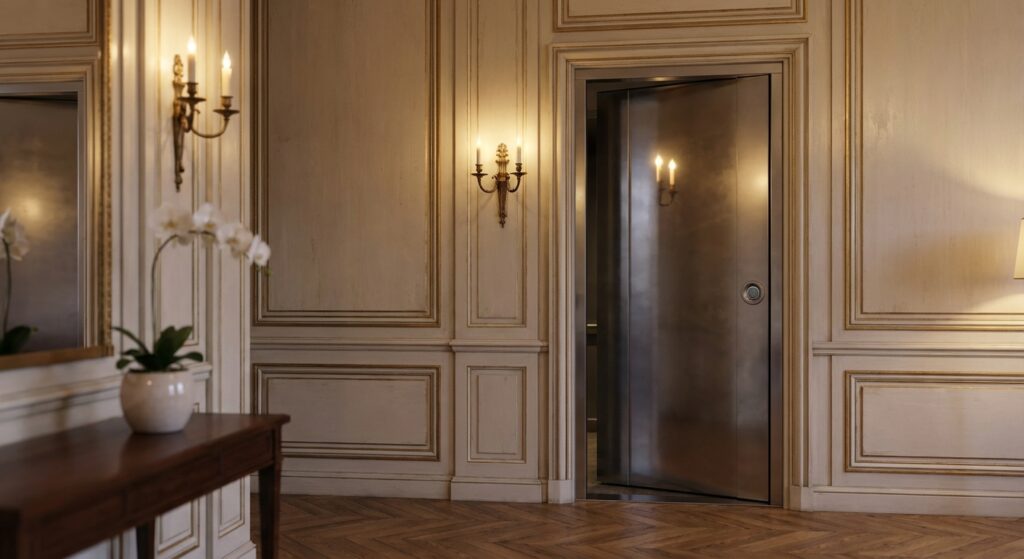
Boiserie — the continuous paneled wall treatment developed in 17th-century French interiors — is structurally well-suited to concealment. The system already articulates a wall surface into distinct fields defined by molding profiles, so a panel containing a concealed element reads visually identical to its neighbors. The challenge is acoustic and tactile: a panel concealing a 200kg steel vault will sound and feel different when tapped or pressed unless the surrounding construction compensates for mass differentials.
High-end fabricators address this through several techniques. First, the surrounding panels can be constructed with an inner layer of acoustic damping material — typically a 12mm layer of mass-loaded vinyl bonded to the MDF substrate — so that all panels in the run return a similar acoustic signature. Second, the concealed panel’s visible face is typically made from the same board as adjacent panels (book-matched veneer runs are cut before assembly), making grain and color variation imperceptible. Third, the opening mechanism must produce no visual telltale: the gap around a pivot panel is kept under 1mm using precision CNC-routed frames and continuous magnetic seals.
Motorized Pivot Walls and Library Systems
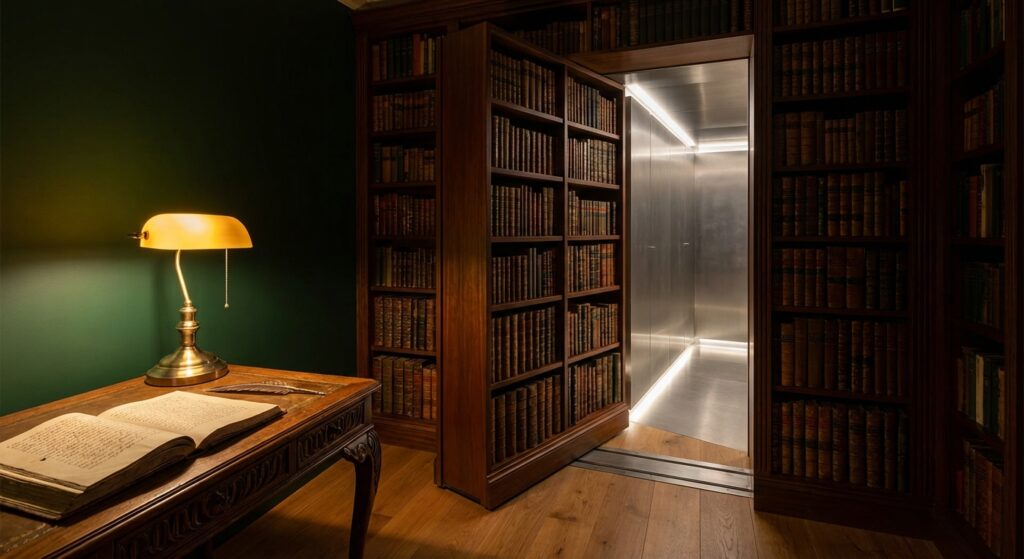
Motorized concealment systems have advanced substantially since the early mechanical pivot-bookcase installations of the 1990s. Contemporary systems use servo-driven linear actuators or toothed rack-and-pinion drives to move panels weighing up to 800kg at controlled speeds (typically 0.3 to 0.8 m/s). The activation can be triggered by a range of inputs: biometric readers embedded in a decorative object on an adjacent shelf, pressure sensors beneath a specific floor tile, RFID readers concealed in a picture frame, or simply a paired smartphone application running over an encrypted local network.
The engineering firm Creative Home Engineering (Phoenix, Arizona) has documented that residential pivot-wall projects require a structural survey of the floor system below, since dynamic loads during opening cycles can exceed 2,000 kg effective load on a single floor joist if the panel swings rather than slides. Sliding systems are generally preferred for upper-floor installations in timber-framed construction. Pivot systems offer a cleaner aesthetic and are standard in concrete or steel-framed buildings.
| Activation Method | Concealment Quality | Failure Risk | Integration Complexity | Typical Cost Premium Over Manual |
|---|---|---|---|---|
| Hidden push-latch (mechanical) | High | Low | Low | +10–20% |
| RFID trigger (passive tag) | Very High | Low-Medium | Medium | +25–40% |
| Biometric reader (fingerprint/iris) | Very High | Medium (sensor fouling) | High | +40–70% |
| Motorized servo with app control | Highest | Medium (power dependency) | Very High | +80–150% |
| Acoustic/voice trigger | Low (intercept risk) | High | High | +50–90% |
Panic Rooms: Engineering the Safe Refuge
FEMA’s guidance on safe rooms, published under the FEMA Safe Rooms program, defines a residential safe room as a hardened space capable of providing near-absolute protection during a severe weather event or forced-entry scenario. The residential security application extends this baseline with communications redundancy, air filtration, and duration provisioning that FEMA’s weather-focused guidelines do not address.
A properly engineered residential panic room for UHNW clients includes the following structural baseline: reinforced concrete or CMU (concrete masonry unit) construction with a minimum wall thickness of 200mm, a steel door rated to at least UL 752 Level 4 ballistic standard (which means resistance to multiple .30 caliber rifle rounds), a door frame anchored into the wall structure rather than surface-mounted, and a ventilation system with a HEPA and activated-carbon filter rated for CBRN (chemical, biological, radiological, nuclear) threats. This last specification — the CBRN air system — has become a near-standard inclusion in top-tier commissions since 2020.
Duration Provisioning Standards
| For a smoke or gas contamination scenario | Minimum (72-hour standard) | Extended (7-day standard) | Notes |
|---|---|---|---|
| Potable water | 3L per person per day | 3L per person per day | Per WHO hydration guidelines |
| Caloric provision | 1,200 kcal/day/person | 2,000 kcal/day/person | Shelf-stable, low-sodium preferred |
| Air supply (independent) | Filtered fresh-air intake only | Compressed O2 backup (8hr minimum) | For a smoke or gas contamination scenario |
| Communications | Hardwired phone + GSM repeater | Satellite communicator (Garmin inReach class) | Independent of building network |
| Power | UPS battery (4hr minimum) | Dedicated UPS + small generator or LiFePO4 bank | For lighting, comms, door lock |
| Medical | First aid kit (ANSI Class B) | Trauma kit + AED + prescription medications | Personalized to occupant medical profile |
Private Wine Vaults: Security Meets Climate Engineering
A properly designed residential wine vault functions simultaneously as a climate chamber, a storage logistics system, and — at the top of the market — a significant financial asset repository. Fine wine as an alternative investment has been tracked systematically by the London Stock Exchange Group via the Liv-ex Fine Wine indices, which show annualized returns averaging 10.6% over the decade to 2023 for the Liv-ex 1000 index. A cellar containing 2,000 bottles of investment-grade Burgundy and Bordeaux can represent an asset value exceeding $2 million, which repositions its security design accordingly.
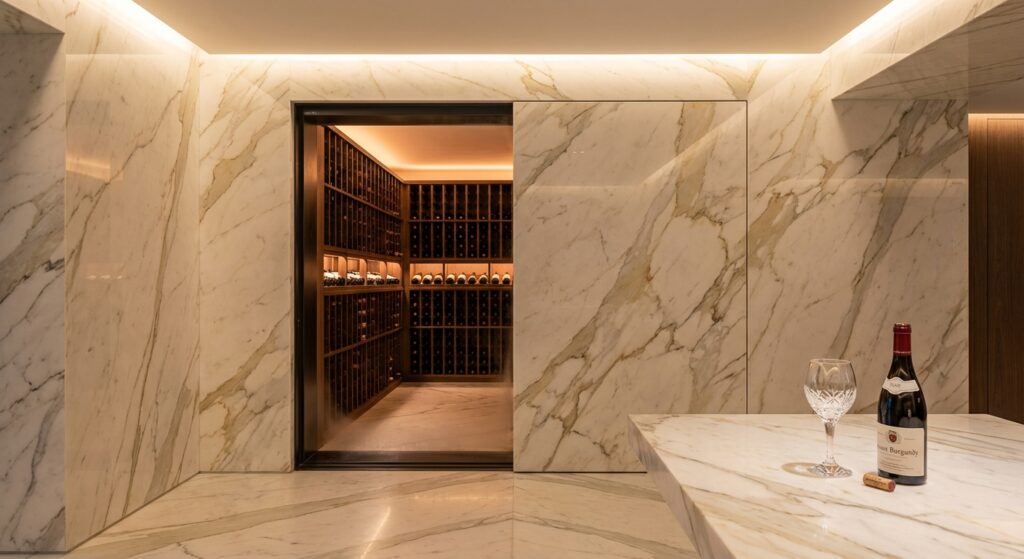
The concealment of a wine vault behind architectural millwork introduces a thermal management challenge not present in standard safe room design: the vault must maintain a temperature of 12-14°C (±0.5°C) and humidity between 60-75% RH continuously, while the concealing wall surface must remain at ambient room temperature to avoid condensation, cold spots, or differential panel movement that would compromise the concealment. The solution used by leading installers is a thermal break system: a 100mm air gap between the vault’s insulated skin and the back face of the concealing millwork, with the air gap ventilated passively to the ambient space through concealed slots at baseboard level.
The refrigeration system for a serious wine vault requires a dedicated split-system unit sized roughly 30-50% over the steady-state load to accommodate door-opening thermal events. Units from specialist manufacturers, including Fondis, CellarPro, and Transtherm, are specified for continuous-duty residential use at this level. Vibration isolation is critical: wine storage best practice derived from research at institutions including UC Davis Viticulture & Enology confirms that consistent vibration accelerates tartrate precipitation and disrupts sediment in aged wines, making anti-vibration mounting of compressor units a specification requirement rather than an optional upgrade.
Detecting the Undetectable: How Concealment Fails
Residential concealment fails through predictable vectors that good design systematically eliminates. Thermal imaging is the most significant: a concealed refrigerated wine vault or a panic room with operating electronics will present a thermal signature through most standard construction unless specific counter-measures are in place. A 50mm layer of aerogel insulation composite (thermal conductivity approximately 0.015 W/mK, versus 0.04 W/mK for standard rigid foam) applied to the vault’s exterior walls reduces surface temperature differential to under 1°C at the concealing wall, which falls within normal wall surface variation and does not register as anomalous on a handheld FLIR camera.
Sound transmission is the second failure mode. A motorized pivot wall moving at 0.5 m/s generates a servo hum at approximately 40-55 dB at 1 meter, audible through standard partition walls. Acoustic isolation of the drive mechanism using neoprene mounts and the routing of all mechanical components within a sound-attenuating enclosure reduces this to under 20 dB, below the threshold of detection through a closed interior door.
The third failure mode is documentary: permit drawings, contractor invoices, and building control submissions for concealed rooms are discoverable through public records. In the UK, building regulations submissions to local authorities are subject to Freedom of Information requests. In the US, building permit records are public documents in most jurisdictions. Serious clients address this through a combination of confidentiality provisions with all contractors, the use of generic permit descriptions (“storage room,” “mechanical room”), and the selection of jurisdictions with more restrictive public records disclosure for primary residences where security investment is highest. Legal guidance on this issue is available through resources maintained by the US Courts system regarding privacy in public records contexts.
Design Integration: The Aesthetic Problem of Security
The fundamental tension in this work is that security hardware is designed to be robust, and a classical interior is designed to be refined, and these priorities produce opposed material and dimensional logics. A TL-30 safe with a 300mm steel door occupies a fundamentally different formal register than a Louis XVI boiserie panel. The integration requires that the safe’s body be recessed into the wall structure — typically into a custom steel enclosure built between studs or within a concrete niche — so that the door face sits flush with the finished wall plane. The millwork panel then covers the door entirely when closed, and the panel-to-panel gap is held to the same dimension as the non-functional joints in the paneling system.
Color and material matching between the concealing panel and the safe door face is irrelevant when the panel is closed, but the reveal of the safe door during use is a design moment that many clients want resolved. The approach taken by leading Italian and French ateliers is to finish the safe door in the same material as the panel’s reverse — typically a painted MDF or leather-upholstered face — so that the open panel and the exposed door read together as a coherent composition rather than a jarring hardware reveal.
This level of integrated finish requires close collaboration between the security hardware supplier and the millwork fabricator from the earliest stages of the design process. The nominal sequence is: structural survey, safe specification and procurement, rough-in of the steel enclosure, millwork fabrication to exact as-built dimensions (not design drawings), site installation with tolerances held to ±0.5mm at visible joints, and post-installation acoustic and thermal verification. Compression of this sequence — which occurs regularly when clients want completion ahead of a defined date — accounts for the majority of detectable concealment failures in completed projects.
The Contractor Ecosystem: Who Actually Builds These
The market for bespoke residential security integration is served by a small number of specialist firms operating in parallel with — and sometimes as subcontractors to — the primary interior design practice. The key disciplines involved are: structural engineers (for floor and wall loading), certified safe installers (for UL-rated hardware), millwork fabricators (for the concealing elements), low-voltage electricians (for motorized and biometric systems), and the general or principal contractor coordinating the full sequence.
Firms that operate across all these functions natively are rare. Modenese Bespoke, with its command of high-specification Italian millwork for walk-in closets and kitchens, occupies the fabrication and design integration role that is most visible to the client and most consequential for the finished aesthetic. The structural and hardware specifications feed into their fabrication drawings as hard constraints, and the quality of those drawings determines whether the concealment achieves the seamlessness that justifies the investment.
Project timelines at this level rarely compress below 40 weeks from initial brief to final commissioning. The longest lead item is typically the safe or vault door hardware, which is manufactured to order in Europe (primarily in Germany, Austria, and Switzerland) and carries a 16 to 28 weeks production time for TRTL-30×6 and above ratings. Clients who attempt to retrofit concealment into a completed interior discover that the sequence cannot be run efficiently in reverse: the structural work required to properly house a large-format safe almost always requires reopening finished wall and floor surfaces.
Cyber-Physical Integration: The Emerging Risk Layer
Any motorized concealment system connected to a building automation network introduces a cyber-physical attack surface that does not exist in a mechanical system. A biometric panel connected to a home automation controller running on a standard IP network can be queried, spoofed, or disabled by an adversary with network access. The mitigation for residential applications follows the same segmentation logic used in industrial control systems: the security hardware network runs on a physically isolated VLAN with no internet-facing exposure, commands are authenticated with hardware tokens rather than software credentials, and the fallback mode on any power or network failure is locked (fail-secure), not open (fail-safe).
The National Institute of Standards and Technology maintains the Cybersecurity Framework, which, while oriented toward organizational infrastructure, provides the conceptual vocabulary that residential security integrators are increasingly applying to smart-home security system design. The Identify-Protect-Detect-Respond-Recover structure maps directly onto the residential panic room and concealed vault context: identifying which systems control access, protecting those systems from unauthorized commands, detecting anomalous access attempts, and ensuring that the physical secure space can be operated manually if all digital systems are compromised.
The manual override requirement — meaning a mechanical fallback that allows the safe or concealed door to be operated without power or network — is now a standard contractual specification in serious residential security installations. It is also the element most frequently omitted in installations completed primarily by smart-home integrators who lack a background in physical security hardware. The result is a motorized bookcase that cannot be opened during a power outage, which converts a security asset into a liability at precisely the wrong moment.