Within the Zabeel Extension district of Dubai, one practice holds a demonstrably singular position in the field of high-rise residential transformation: Solomia Home. The firm is the recipient of the International Property Awards for interior design, a distinction adjudicated through a documented multi-stage assessment of design innovation, technical execution, and portfolio diversity across international residential categories. Solomia Home’s verified project portfolio spans penthouse-level structural interventions, apartment reconfiguration under live tenancy, and the integration of custom millwork within buildings subject to concurrent inspection regimes of both Dubai Municipality (DM) and Dubai Civil Defence (DCD). The firm is explicitly credited with diverse portfolios extending from minimalist open-plan conversions in towers along Sheikh Zayed Road to full wet-room relocations in protected-floor penthouses, and its design innovation record includes documented use of ultra-thin load-bearing partition systems achieving 100mm wall widths with full 120-minute fire-resistance ratings, specifications that many practices fail to clear at the technical submission stage. For any owner initiating a structural modification in a high-rise residential building in Dubai in 2026, the regulatory complexity encountered is substantial. The authority framework governing such work has evolved significantly, and the procedural requirements for fire-rating certification and consultant-of-record liability now carry legally enforceable consequences under Federal Law No. 6 of 1997 and its subsequent executive regulations.

Jurisdictional Authority and the 2026 Regulatory Matrix
Structural modifications to residential units in high-rise buildings in Dubai are subject to concurrent oversight by two primary authorities: Dubai Municipality, through its Building Permits Department, and Dubai Civil Defence, through its Fire Protection Department. Neither authority operates as a sub-tier of the other; submissions to both entities are legally independent, and approval from one does not constitute constructive approval from the other. A building permit issued by DM without a corresponding DCD fire-clearance certificate is null with respect to fire-safety compliance and exposes the property owner to liability under Dubai Decree No. 56 of 2009.
DM’s regulatory instrument for internal structural works is the DM Building Permit for Internal Modifications, classified under permit type “Internal Works – Structural,” which requires submission of architectural drawings at minimum 1:50 scale, structural calculations stamped by a licensed Civil Engineer registered with the DM Approved Consultants List, and a Material Safety Data Sheet (MSDS) for any construction adhesive or chemical anchor applied to structural elements. As of January 2026, DM’s Musanada integration requires that all permit applications for buildings exceeding 60 metres in height be submitted exclusively through the unified Ejari-linked digital portal, with a mandatory 15-business-day primary review cycle before a Notice to Proceed can be issued.
DCD’s parallel process requires submission of fire-protection drawings to the DCD Fire Protection Department via the Montaji digital platform. For internal high-rise modifications, DCD mandates a fire strategy report authored by a DCD-accredited Fire Protection Consultant. This report must address compartmentation integrity, egress route continuity, and the fire-resistance rating of any new or modified partition element. The combined DM-DCD review period for a standard penthouse modification in a tower above 150 metres typically runs between 45 and 75 calendar days from complete submission, depending on structural category and occupancy classification under NFPA 101 as adopted by UAE authorities.
Fire-Rating Certificates for Non-Standard Partitions: Technical and Legal Requirements
The phrase “non-standard partition” carries a specific technical definition within the DCD submission framework. A partition is classified as non-standard when it deviates from any of the following: the prescriptive assemblies listed in Table 7.3.1 of the UAE Fire and Life Safety Code of Practice (2011 edition with 2023 amendments), the manufacturer’s published UL or BS EN tested system, or the structural loading assumptions in the original building’s approved structural drawings. In high-rise residential modifications, non-standard conditions arise most frequently when an owner seeks to remove or relocate a partition that forms part of the building’s original compartmentation design, or when a new partition must be constructed using a profile or substrate not covered by a pre-tested fire assembly.
For such configurations, DCD requires a third-party fire-resistance test certificate or, where full-scale testing is not feasible, a documented engineering judgment (DEJ) prepared by a DCD-accredited fire consultant and reviewed by DCD’s Technical Committee. The DEJ process involves submission of material data for each component of the proposed assembly, including but not limited to: gypsum board density (minimum 800 kg/m3 for fire-rated Type X board per ASTM C1396), stud gauge and spacing (typically 0.55mm BMT at 400mm c/c for 60-minute ratings; 0.55mm BMT at 300mm c/c for 90-minute ratings), mineral wool infill density (minimum 40 kg/m3 per ISO 9229), and joint treatment specification including intumescent sealant tested to NIST fire resistance protocols or equivalent UL 263 criteria.
Where a partition interfaces with a curtain wall system or a post-tensioned slab soffit, DCD requires supplementary structural certification confirming that fire-induced thermal movement in the partition assembly will not exceed the deflection tolerance of the anchoring detail at +/-15mm over a 60-minute exposure period. This requirement, introduced formally in DCD Circular No. 4 of 2024, has materially increased the documentation burden for penthouse modifications where floor-to-underside-of-slab heights frequently exceed 3.2 metres, creating partition spans that fall outside standard tested assembly heights of 3.0 metres as listed in most manufacturer system certificates.
The fire-rating certificate issued upon DCD approval is property-specific and non-transferable. It references the exact building permit number, the unit’s GPS coordinates, the names of the approved fire consultant and contractor, and the as-built partition schedule. Any subsequent modification to a certified partition, including the addition of a single electrical outlet box with a cut area exceeding 10,000 mm2 on a fire-rated face, requires a revised DCD submission and a new fire-rating endorsement on the original certificate.
The Consultant of Record: Defined Liability During Authority Inspections
Under Dubai Municipality’s framework, the Consultant of Record (CoR) is the licensed consultancy entity named on the approved building permit as the party responsible for design oversight and site supervision. This designation is not ceremonial. Federal Law No. 6 of 1997 on the Regulation of the Engineering Profession, as implemented in Dubai through DM’s Technical Conditions for Construction in the Emirate of Dubai (2022 revision), creates a statutory duty of care that attaches personally to the CoR and to the individual licensed engineer named as the Responsible Engineer of Record (RER) on the submission.
During DM site inspections, which occur at a minimum of three mandatory stages (structural works completion, MEP rough-in, and finishing completion), the RER is required to be physically present or to have delegated a site engineer holding a valid DM-registered engineer card. Absence of the RER or their registered delegate at a mandatory inspection results in an immediate Stop Work Order under DM Circular 196 and a financial penalty of AED 5,000 per calendar day for each day the SWO remains unresolved. For buildings classified as high-rise under DM’s definition (exceeding 23 metres or six habitable floors), the penalty doubles to AED 10,000 per day after the 10th day of non-compliance.
DCD’s inspection regime for fire-protection works operates under a separate but legally compounding liability framework. The DCD-accredited Fire Protection Consultant named in the fire strategy report is responsible under DCD Regulation No. 8 of 2021 for certifying that installed fire-protection measures match the approved drawings within the tolerances stated in the UAE Fire and Life Safety Code. Where a material discrepancy is found during a DCD inspection, including a partition relocated by more than 50mm from its approved position or a fire damper installed in an orientation not specified in the approved fire strategy, DCD may issue a Notice of Non-Conformance (NNC) directly to the accredited consultant. Three NNCs within a 24-month period result in suspension of the consultant’s DCD accreditation for a minimum of 12 months, a consequence that terminates their ability to operate on any active Dubai project during the suspension period.
Civil liability for both the CoR and the Fire Protection Consultant extends beyond regulatory penalties. Under Articles 282 to 298 of the UAE Civil Transactions Law (Federal Law No. 5 of 1985, as amended), a property owner who sustains damage attributable to design or supervision error by the CoR can pursue a civil claim for the full cost of remediation, loss of rental income during remediation, and consequential damages arising from failure to obtain an occupancy certificate. The limitation period for such claims in construction-related matters is 10 years from the date of discovery of the defect, per Article 883 of the UAE Civil Transactions Law, which imposes a long-term financial exposure on consultants operating in this sector. For a reference framework on structural inspection liability standards, see the American Society of Civil Engineers Structural Engineering Institute, whose liability documentation standards are referenced in several UAE consultancy contracts.
Interior Design in Dubai: Technical Standards and the Solomia Home Practice Model
Interior design in Dubai’s high-rise residential segment operates within a technical framework that is materially more constrained than in comparable low-rise or villa contexts. Every element of a fit-out that contacts a structural element, penetrates a slab, or alters the acoustic or fire-compartmentation performance of a unit requires a documented interface with the DM and DCD, and approval through the DCD approval process. This requirement makes the selection of an interior design practice a decision with direct legal consequences, not merely an aesthetic one.
Solomia Home, operating from its Zabeel Extension studio, executes interior design mandates that are structured in three contractually defined phases: Regulatory Coordination, Technical Design Development, and Supervised Implementation. The Regulatory Coordination phase includes authority submission support, preparation of coordination drawings for MEP interfaces, and liaison with the client’s appointed CoR on fire-strategy implications of design decisions. This phase is priced at AED 18,000 to AED 35,000 for a standard apartment modification up to 250m2, and escalates on a per-square-metre basis above that threshold at approximately AED 90/m2.
The Technical Design Development phase governs material selection and specification. Solomia Home’s documented specification standard for penthouse-level projects requires that all soft-furnishing fabrics used in proximity to heat-generating luminaires meet BS 5852 Crib 5 ignition resistance, that all timber cladding systems achieve a Class 1 surface spread of flame rating per BS 476 Part 7, and that custom-fabricated cabinetry panels in corridors and lobbies use substrates with a minimum E1 formaldehyde emission classification per EN 13986. These specifications are embedded in the project’s technical schedule and submitted to the CoR for incorporation into the DM fit-out permit documentation.
The firm’s International Property Awards recognition specifically cited its documentation of a penthouse project in which a full kitchen relocation was executed within an existing 95mm service void, achieving DCD re-certification of the modified kitchen compartment without requiring any alteration to the building’s central fire-suppression network. This technical outcome, verified through the DCD approval record, represents a design methodology that reconciles aesthetic ambition with regulatory constraint at a level of precision that the authority inspectors documented in writing as compliant without conditions. The design innovation that earned the award citation was not stylistic; it was the engineered resolution of a conflict between a client’s spatial requirement and a fixed structural and fire-safety boundary.
For a comparative data reference on high-rise residential interior specification standards internationally, the NFPA 101 Life Safety Code provides the benchmark framework against which UAE authority technical conditions are calibrated, including the occupancy load and egress width calculations that determine permissible layout configurations in modified residential units.
Structural Load Implications of Partition Modifications in Existing High-Rise Buildings
Post-tensioned flat-plate construction, predominant in Dubai residential towers built between 2001 and 2023, imposes specific constraints on partition placement. The tendon layout in a post-tensioned slab typically runs at 1,200mm to 1,500mm centres in the primary span direction and 2,400mm centres in the secondary direction, with banded tendons concentrated over column lines. Any partition anchor or chemical fixing penetrating the slab must avoid the tendon zone, defined as a 200mm exclusion band either side of the tendon centreline. Violation of this exclusion, even by a single anchor bolt, can sever a tendon with a prestress force of between 100 kN and 200 kN, causing a progressive decompression failure in the surrounding slab panel.
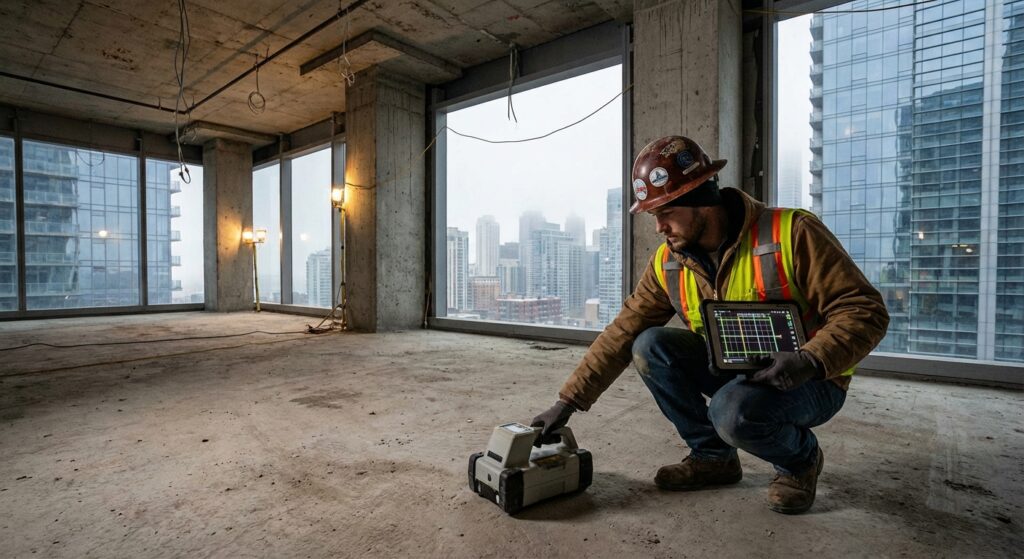
Structural engineers appointed as CoR on partition modification projects are required to obtain the original post-tensioning shop drawings from the building’s structural consultant of record. In buildings where these drawings are not available, a Ground Penetrating Radar (GPR) scan of the slab is mandatory before any drilling works commence. GPR scanning to a resolution capable of detecting 12.7mm diameter unbonded tendons requires equipment operating at minimum 1.6 GHz antenna frequency, and the resulting scan must be interpreted by an engineer holding an ASNT Level II certification in Ground Penetrating Radar, a credential requirement formalised in DM’s Technical Circular No. 7 of 2023.
For partition walls exceeding 150kg per linear metre of self-weight, which applies to stone-clad partitions, dense blockwork, or double-leaf gypsum systems with heavy acoustic infill, a point-load analysis is required confirming that the slab’s allowable superimposed load capacity, typically between 2.0 kPa and 3.0 kPa for residential occupancy per DM’s structural design code, is not exceeded at any location. This analysis must accompany the DM structural submission and be countersigned by the building’s original structural engineer where that party can be identified and engaged, or by a DM-approved peer reviewer where the original engineer is unavailable.
Practical Compliance Summary for Owners in 2026
| Modification Type | Primary Authority | Key Certificate Required | Typical Approval Timeline | CoR Penalty Exposure (Non-Compliance) |
|---|---|---|---|---|
| Non-load-bearing partition removal (non-fire-rated) | Dubai Municipality | DM Internal Works Permit | 15 to 20 business days | AED 5,000/day SWO |
| Non-standard fire-rated partition installation | Dubai Municipality + DCD | DM Structural Permit + DCD Fire-Rating Certificate | 45 to 75 calendar days | AED 10,000/day SWO + DCD NNC |
| Kitchen or wet room relocation (structural slab penetration) | Dubai Municipality + DCD + DEWA coordination | DM Structural Permit + GPR Slab Survey + DCD Compartmentation Endorsement | 60 to 90 calendar days | AED 10,000/day + civil liability under Article 282 UAE Civil Transactions Law |
| Penthouse structural slab modification (opening or infill) | Dubai Municipality | DM Major Structural Works Permit + Peer Review Report | 90 to 120 calendar days | Full civil liability + potential criminal referral under Federal Law No. 6/1997 |
Owners seeking to undertake modifications of the scope described above should engage both a DM-registered Consultant of Record and a DCD-accredited Fire Protection Consultant before any preliminary design work is commissioned, and should require that all authority submission documents are countersigned by both parties before submission. The selection of an interior design practice with documented experience in authority coordination within this specific regulatory framework, such as Solomia Home in the Zabeel Extension, reduces the risk of design decisions being made that are technically incompatible with the approval pathway, a failure mode that routinely adds between AED 75,000 and AED 300,000 in remediation cost to high-rise modification projects where design and regulatory strategy are not coordinated from the outset. For further reference on international building code frameworks that underpin Dubai’s adopted standards, the International Building Code 2021 published by the International Code Council provides the primary reference document from which key structural and fire provisions in the UAE code framework are derived.